IPv6 has been "the future of the internet" for 30 years. The standard was finalized in 1998. IPv4 address exhaustion became official in 2011 when IANA distributed the last blocks to the regional registries. Yet in 2026, somewhere between 43% and 55% of internet traffic is still IPv4 — depending on who's counting and how.
Here's the full picture, broken down by country, region, and time — with the uncomfortable nuances most articles leave out.
Why the Numbers Are Complicated
Before the data: there are three different things people mean when they say "IPv6 adoption," and they give meaningfully different numbers.
Google's measurement — the percentage of users who access Google over IPv6. This is the most cited number and probably the most useful: it measures actual deployed, working IPv6. Google's global figure sits around 47–55% depending on the day. Weekends skew higher because mobile users (who are often IPv6-native) dominate over corporate/office IPv4 networks.
APNIC's measurement — the percentage of internet users whose networks are capable of IPv6, regardless of whether they're currently using it. More conservative, typically 5–10 points lower than Google's figure.
Government self-reporting — China's Ministry of Industry and Information Technology claims 77% IPv6 adoption and 865 million active IPv6 users. APNIC and Cloudflare Radar measure China at approximately 34–38%. Both can be technically "true" depending on whether you measure network capability announcements or actual end-to-end IPv6 traffic.
This matters because when you read a headline like "Global IPv6 adoption hits 50%," the underlying methodology determines whether that's cause for celebration or cautious optimism.
Country Rankings — April 2026
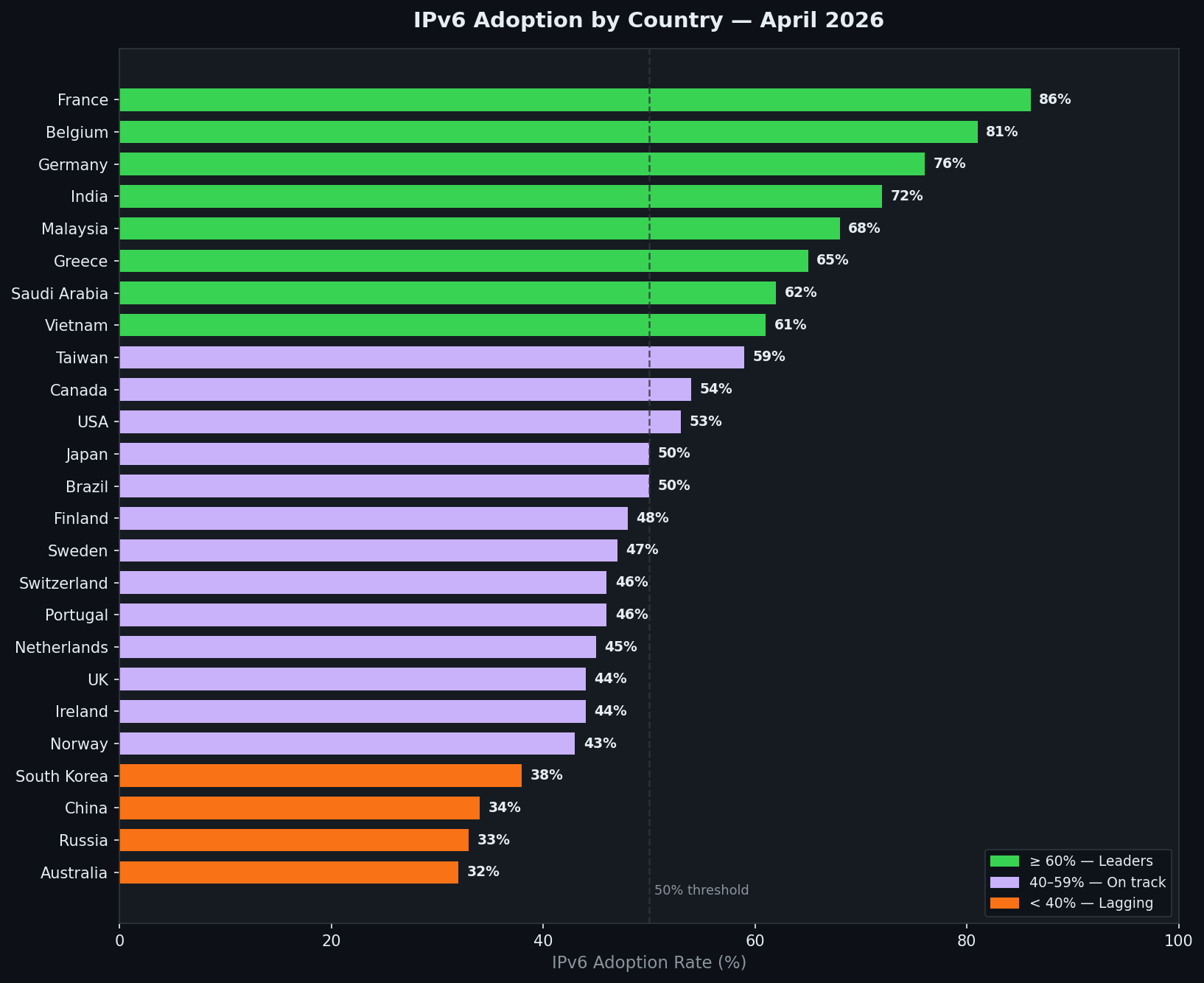
France: 86% — the clear global leader, driven by ISPs Free and Orange deploying dual-stack and IPv6-only configurations at scale. Free's broadband network has been IPv6-by-default for years.
Belgium: 81% — Proximus and Telenet's aggressive dual-stack deployments pushed Belgium into the top tier. Small country, strong regulatory push.
Germany: 76% — Deutsche Telekom's commitment to IPv6 and the country's large fixed-broadband base (which deploys IPv6 faster than mobile-heavy markets) makes Germany a consistent top performer.
India: 72% — the most interesting story. Reliance Jio's 4G rollout in 2016 deployed IPv6-by-default across its 400+ million subscribers. When the world's largest greenfield mobile network is IPv6-native from day one, adoption follows.
USA: 53% — higher than most people expect, but still laggard relative to European peers. The reason: enterprise IT. American corporations run enormous IPv4 private networks behind NAT. Home ISPs (Comcast, AT&T, T-Mobile) have actually done well on IPv6. But enterprise campus networks drag the average down.
Australia: 32% — surprising for a wealthy developed nation. Telstra and Optus were slow to deploy dual-stack. The NBN rollout didn't mandate IPv6 initially. Australia is catching up but started late.
China: 34% (Cloudflare/Google methodology) — the gap between official claims (77%) and independent measurements (34%) reflects a difference in what's being measured. China's IPv6 addresses are assigned and announced; the actual end-to-end IPv6 user sessions measured by Google and Cloudflare are significantly lower.
Russia: 33% — sanctions and internet infrastructure politics have slowed cross-border investment and IPv6 transition projects. Domestic traffic increasingly runs over internal IP space.
The Global Adoption Curve
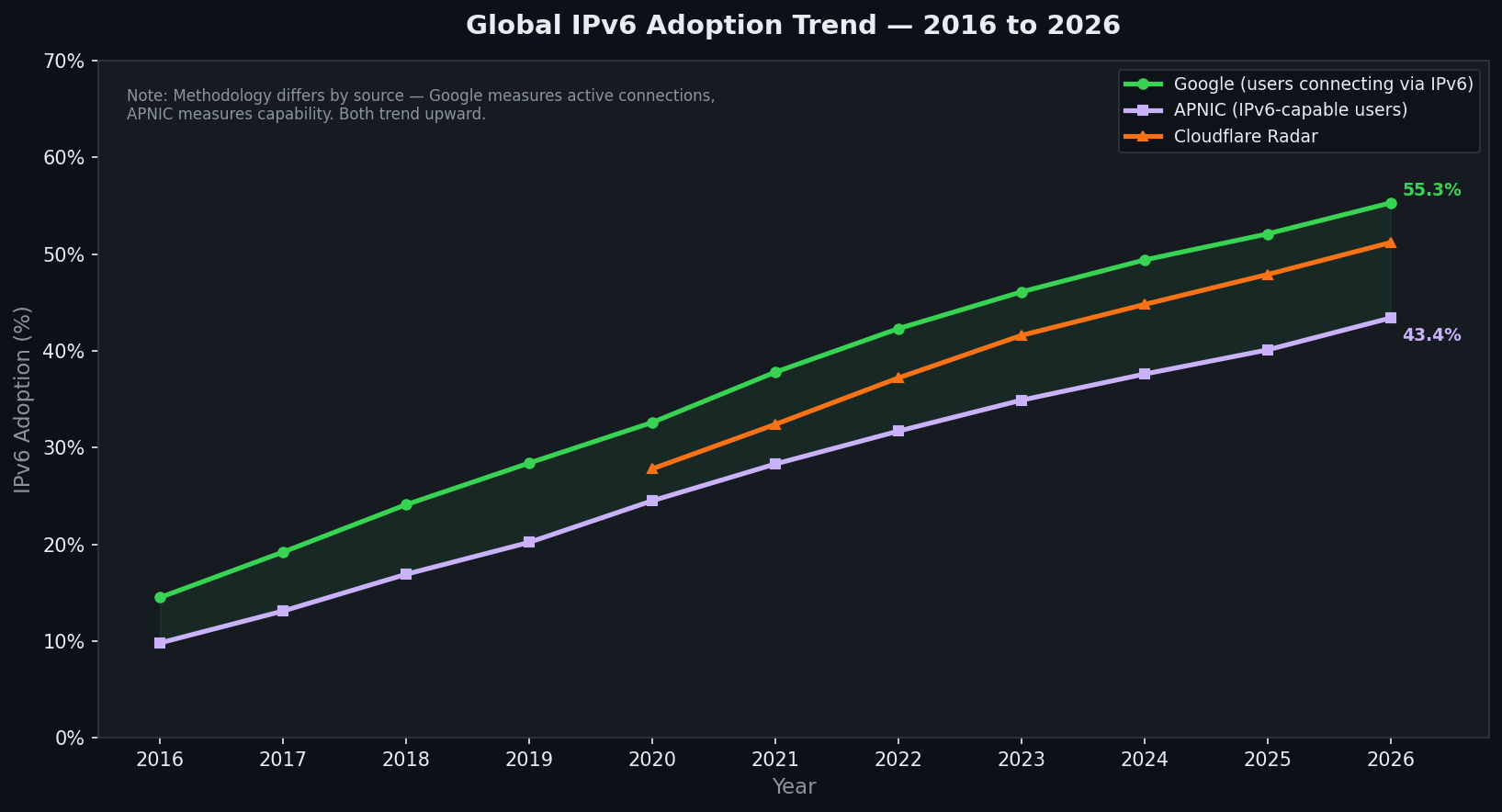
The shape of this curve tells a story:
2016–2018: The acceleration. Jio's India launch (2016), mobile network deployments in Europe, and US ISP dual-stack rollouts drove the steepest growth. Google's number went from ~14% to ~24% in two years.
2019–2022: Linear growth. Once the easy wins (new mobile networks, new ISP deployments) were captured, the remaining IPv4 users became harder to convert. Enterprise networks, embedded systems, older ISPs — these move slowly. Growth continued at roughly 4–5 percentage points per year.
2023–2026: Continued but decelerating. The "ceiling" effect. Every new subscriber added to a major IPv6-native mobile network is a gain. But upgrading existing corporate infrastructure is expensive, disruptive, and often deprioritized. The global number now grows by 3–4 points annually.
The honest projection: IPv6 will likely reach 65–70% global adoption by 2030, not the 100% that was optimistically predicted when IPv4 exhaustion became official. The remaining hold-outs — legacy enterprise NAT, embedded IoT on IPv4, regulatory-mandated IPv4 infrastructure in some countries — won't fully transition this decade.
Regional Breakdown
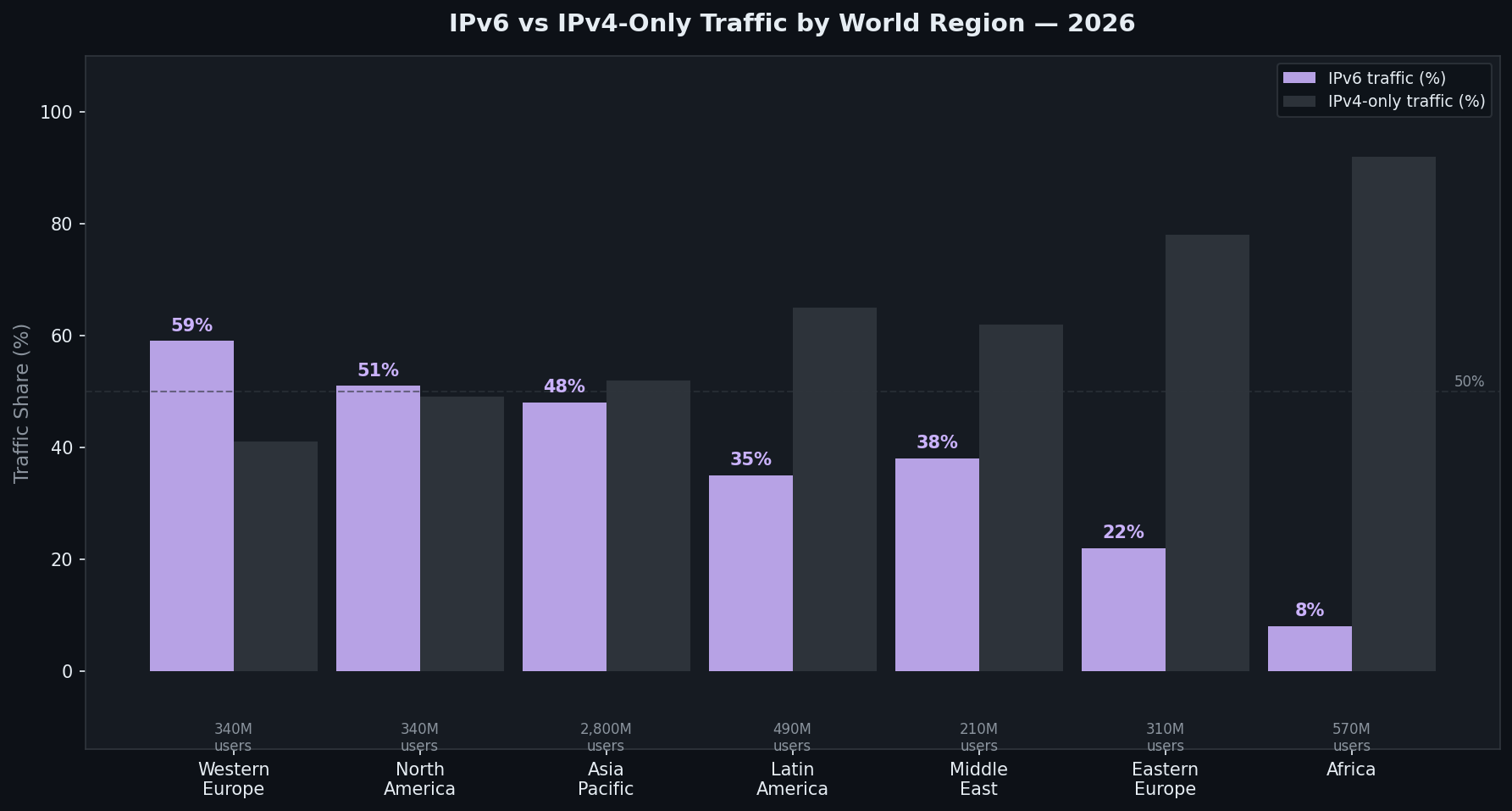
The regional chart reveals the practical problem: Africa has 570 million internet users and 8% IPv6 adoption. That's not a rounding error — it's 524 million people on IPv4-only connections, relying on CGNAT (carrier-grade NAT), shared IP addresses, and increasingly complex workarounds to connect to an internet that was designed around the assumption of unique IP addresses.
The situation in Africa is driven by:
- CGNAT proliferation — mobile carriers assign one public IPv4 address to dozens or hundreds of users simultaneously. You can still browse the web, but hosting a server, gaming peer-to-peer, or running any inbound connection is effectively impossible.
- Legacy infrastructure — incumbent telcos with established IPv4 networks have little commercial incentive to invest in dual-stack upgrades.
- Cost — IPv6 deployment requires hardware, software, and training investment that smaller ISPs can't easily absorb.
Eastern Europe's 22% is also lower than you might expect for a region with significant tech infrastructure. Historical investment patterns in telecoms during the Soviet era and post-Soviet transition left many countries with older switching infrastructure that's expensive to upgrade.
The IPv4 Scarcity Signal Nobody Talks About
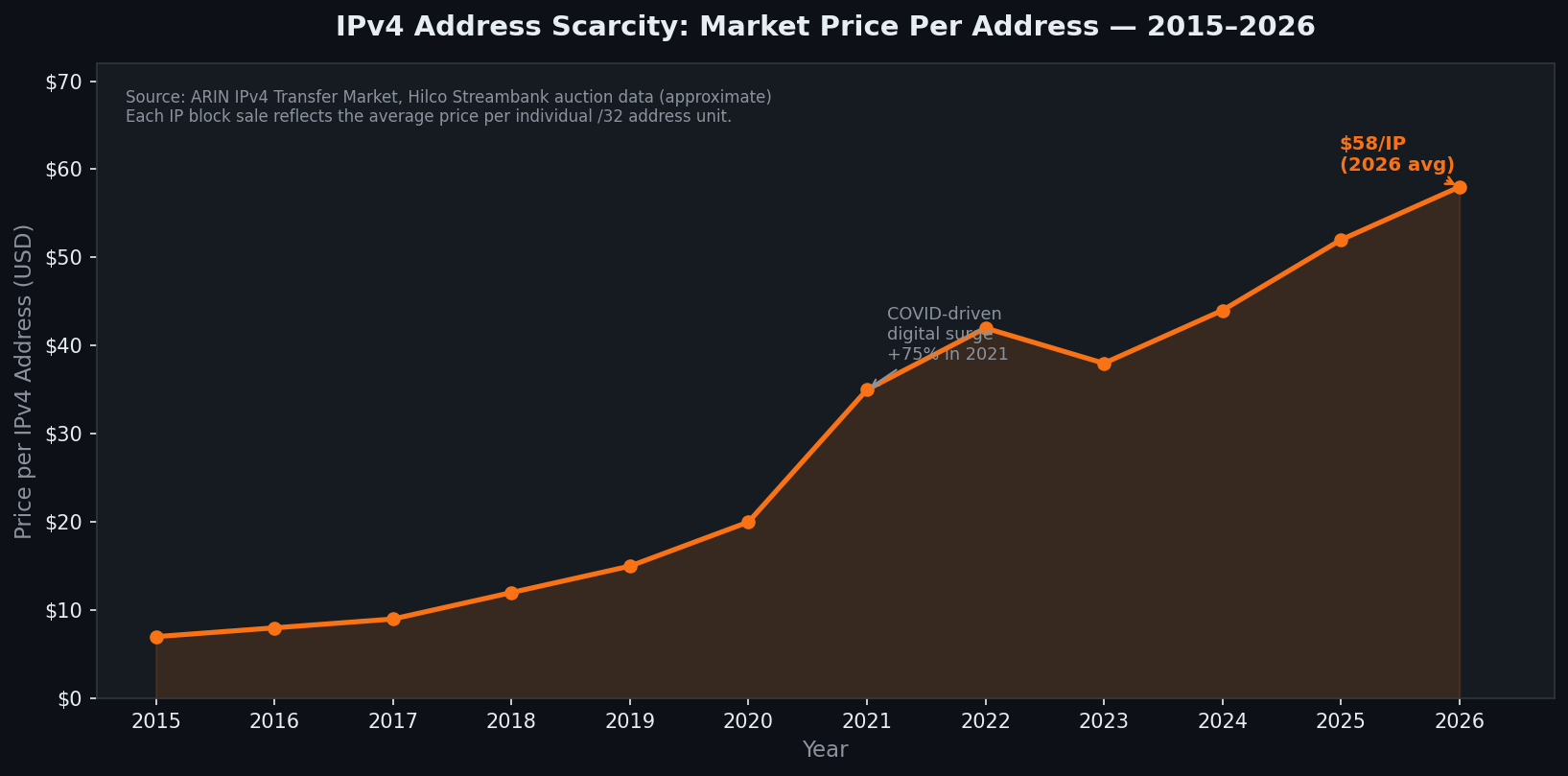
An IPv4 address cost roughly $7 in 2015. Today it's approximately $55–60. That 8× price increase over a decade is the market's signal that scarcity is real — and it's making IPv6 deployment economics look increasingly attractive.
The 2021 spike (+75%) was driven by the pandemic-era digital surge: companies that had coasted on IPv4 suddenly needed more IP space for expanded remote workforces, cloud infrastructure, and new digital services.
Why this matters for you: If you run a business with IP space allocated before 2010, your address block has a non-trivial market value. Organizations like Microsoft (bought 666,624 IPv4 addresses from Nortel for $11.25/each in 2011 — now worth ~$37 million at today's prices) have realized this. Conversely, any new business starting an internet service today faces real costs to acquire IPv4 space that didn't exist a decade ago. This is the economic pressure driving ISPs toward IPv6.
What's Actually Blocking the Remaining 50%
The technical case for IPv6 has been settled for 20 years. The barriers that remain are organizational, not technical.
Enterprise NAT inertia. Large corporations run internal networks of 10.x.x.x and 192.168.x.x addresses behind NAT. This works fine for outbound connections. It's cheap and familiar. The IT team that maintains it has spent years developing expertise in this model. The argument for change is long-term and abstract ("IPv4 addresses are getting expensive") while the cost of change is immediate and concrete (weeks of work, risk of outages, retraining).
Embedded and IoT devices. Industrial control systems, medical devices, building management systems, and older IP cameras often have IPv4 hardcoded at the firmware level. Upgrading them means replacing hardware, not just reconfiguring software. A hospital running IPv4-only ventilator management systems isn't switching to IPv6 next quarter.
CGNAT as a short-term fix. Carrier-grade NAT allows ISPs to share a single IPv4 address among hundreds of customers. It's technically messy (breaks certain gaming protocols, peer-to-peer applications, and self-hosted services) but it works for the average consumer who just wants to load web pages. ISPs that have invested in CGNAT infrastructure have less urgency to deploy IPv6.
Content delivery networks. If a website is only available over IPv4, its visitors won't use IPv6 even if their connection supports it. CDN and hosting provider IPv6 support has improved dramatically (Cloudflare, Fastly, and AWS all support IPv6 natively), but plenty of smaller hosting providers and legacy web applications remain IPv4-only.
Does Any of This Affect You Right Now?
If you're on a modern mobile network in Europe, India, or North America — probably not. Your phone is almost certainly using IPv6 for most connections without you knowing it.
Check your current IP version:
- What is my IP address → — if the result shows an IPv6 address (the long colon-separated format like
2a01:4f8:...), you're connected via IPv6. - IPv6 vs IPv4 — what's the difference? → — if you want the full technical explainer.
Where you're more likely to notice:
- Self-hosting / home servers: if your ISP is CGNAT (you share a public IPv4 with other customers), you can't accept inbound connections on IPv4. IPv6 is often the only way to host a service reachable from the public internet.
- Gaming: some peer-to-peer game protocols work better with unique IP addresses. CGNAT can cause NAT type issues.
- IPv6-only networks: some mobile carriers in Europe are beginning to deploy IPv6-only networks with IPv4 translation (464XLAT). If you're on one of these and your app doesn't support IPv6, it might break.
You can check whether your connection is CGNAT by looking up your IP address here and comparing it to your router's WAN address. If they're different, you're behind CGNAT.
The Forecast
IPv6 will continue its slow, steady march forward. The economic pressure from IPv4 scarcity ($58/address and rising) is providing the financial incentive that the technical arguments never fully provided. New infrastructure — new ISPs, new cloud providers, new mobile networks in developing markets — deploys IPv6 by default.
But the remaining IPv4 holdouts are sticky. The internet won't be fully IPv6 in this decade. What's more likely: a long coexistence period where IPv6 traffic grows as a percentage while IPv4 infrastructure is maintained for legacy systems, with dual-stack as the operational norm for the next 10–15 years.
France's 86% is achievable for other countries. It required ISP commitment, regulatory direction, and willingness to accept the transition costs. Countries that make that commitment now will find it cheaper than making it in 2030 when IPv4 addresses cost $100 each.
Related tools and reading:
- Check your IP address (IPv4 or IPv6) →
- IPv4 vs IPv6 — full technical comparison →
- What is CGNAT and how to check if you're behind it →
- DNS over HTTPS explained →
- What is an ASN? →
--- Data sources: Google IPv6 Statistics, Cloudflare Radar IPv6 Report, APNIC IPv6 Measurement, Internet Society IPv6 Statistics, ARIN Transfer Market. Charts generated from aggregated measurements, April 2026.