When people think about computer networks, they usually picture one of two things: a small home or office network, or the vast global internet. But there is an important category of network that sits right between those two extremes. A Metropolitan Area Network, commonly abbreviated as MAN, connects multiple local area networks across a city, campus, or region, providing high-speed communication over distances that are too large for a LAN but too small to justify a full WAN deployment.
How a Metropolitan Area Network Works
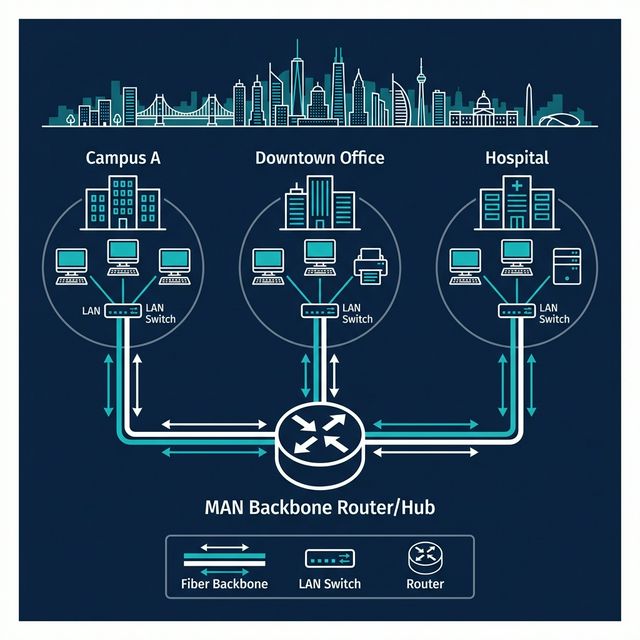
A MAN functions by linking together several LANs within a defined geographic area, typically spanning anywhere from 5 to 50 kilometers. The backbone of a MAN is almost always built on fiber optic cabling, which provides the bandwidth and reliability needed to carry large volumes of data across city-scale distances.
The Fiber Backbone
At the heart of every MAN is a high-speed fiber optic backbone. This backbone connects major network nodes, such as data centers, central offices, and campus distribution points, using either dedicated fiber owned by the organization or leased dark fiber from a telecommunications provider. Dark fiber refers to unused fiber optic lines that have already been installed in the ground but are not actively carrying traffic, making them available for lease.
Fiber is the medium of choice because it supports extremely high data rates, often 10 Gbps or more, while being resistant to electromagnetic interference and capable of spanning long distances without signal degradation.
Routing and Switching Infrastructure
Routers and switches form the active infrastructure of a MAN. Routers sit at the edges and intersections of the network, making decisions about how to forward data packets between different network segments based on IP addresses. Switches handle traffic distribution within each local segment, forwarding frames based on MAC addresses.
Together, these devices ensure that data moves efficiently from one LAN to another across the metropolitan area. Modern MANs may also incorporate software-defined networking principles, allowing centralized management and automated configuration of network policies across all connected sites.
Wireless MAN Technologies
While fiber is the dominant technology, some MANs incorporate wireless links for locations where laying cable is impractical or too expensive. Point-to-point microwave links, millimeter wave radio, and private 5G networks can all serve as wireless backbone connections within a MAN. These wireless links typically connect buildings across streets, rivers, or other obstacles where trenching fiber would be difficult.
MAN vs. LAN vs. WAN
Understanding where a MAN fits in the hierarchy of network types helps clarify its purpose.
Local Area Network (LAN): A LAN covers a single building or a small group of adjacent buildings. It is typically owned and managed by one organization and uses Ethernet or Wi-Fi for connectivity. A LAN might span a few hundred meters at most.
Metropolitan Area Network (MAN): A MAN spans a city or large campus, interconnecting multiple LANs. It uses fiber optic backbones and can cover distances up to about 50 kilometers. A MAN may be owned by a single organization or operated by a service provider that sells connectivity to multiple clients.
Wide Area Network (WAN): A WAN spans entire countries or continents, connecting geographically distant locations. The internet itself is the largest WAN. WANs typically rely on leased lines from telecommunications carriers and introduce higher latency than MANs due to the greater distances involved.
The key distinction is scale and purpose. A MAN is specifically designed for metropolitan-scale connectivity, delivering speeds and latency closer to what you would expect from a LAN while covering a much larger geographic area.
Real-World Examples of Metropolitan Area Networks
MANs are more common than most people realize. They operate quietly behind the scenes in many urban environments.
University Campuses
Large universities often span dozens of buildings spread across a city. A MAN connects lecture halls, libraries, research labs, dormitories, and administrative offices into a single unified network, enabling resource sharing, centralized authentication, and high-speed access to research databases.
City Government Networks
Municipalities use MANs to interconnect city hall, police stations, fire departments, public utilities, and traffic management systems. Cities like New York have deployed MANs that connect traffic lights, parking meters, and public Wi-Fi hotspots, enabling coordinated smart city operations.
Healthcare Systems
Hospital networks are a natural fit for MANs. A healthcare system with multiple hospitals, clinics, and research facilities within a metropolitan area can use a MAN to share patient records, transmit medical imaging in real time, support telemedicine consultations, and maintain centralized backup systems.
Corporate Campus Networks
Large technology companies and financial institutions with multiple office buildings in the same city frequently build MANs to connect their sites. This allows employees at different locations to access shared servers, communicate via internal voice and video systems, and collaborate on the same network without relying on the public internet.
Internet Service Providers
ISPs use MANs as the infrastructure that connects their central switching offices to neighborhood distribution points and ultimately to customer premises. The MAN is the high-speed layer that aggregates traffic from thousands of individual connections and funnels it toward the ISP's wider backbone network.
Advantages of a Metropolitan Area Network
MANs offer several compelling benefits compared to alternative approaches.
- High Speed: Fiber-based MANs deliver multi-gigabit speeds, enabling bandwidth-intensive applications like video streaming, cloud computing, and large data transfers between sites.
- Lower Latency: Because traffic stays within the metropolitan area rather than traversing long-haul WAN links, latency is significantly lower, which benefits real-time applications like VoIP and video conferencing.
- Centralized Management: Connecting multiple sites on a single MAN allows network administrators to manage security policies, software updates, and access controls from one location.
- Cost Efficiency: For organizations with multiple sites in the same city, a MAN can be more cost-effective than maintaining separate internet connections at each location or leasing expensive WAN circuits.
- Scalability: New sites can be added to the MAN by extending fiber or wireless links to additional buildings without redesigning the entire network.
Limitations to Consider
Despite their strengths, MANs come with challenges.
- High Initial Cost: Deploying fiber optic infrastructure is expensive, particularly in urban environments where trenching through streets and obtaining permits adds complexity and cost.
- Geographic Limitation: By definition, a MAN is limited to a metropolitan area. Organizations with offices in multiple cities still need WAN connectivity between their MANs.
- Complexity: Managing a MAN requires specialized networking expertise. The routing, switching, and security configurations across a city-scale network are more complex than those of a single-site LAN.
- Dependence on Infrastructure: If the fiber backbone is damaged by construction, natural disasters, or other physical events, large portions of the network can go offline simultaneously.
The Future of Metropolitan Area Networks
MANs continue to evolve alongside broader networking trends. The rollout of 5G networks is creating new possibilities for wireless MAN connectivity, potentially reducing the dependence on physical fiber for last-mile connections. Software-defined networking and network function virtualization are making MANs more flexible and easier to manage at scale. And as cities become smarter, with connected infrastructure ranging from traffic systems to environmental sensors, the demand for reliable metropolitan-scale networking is only growing.
Conclusion
A Metropolitan Area Network fills the critical gap between local networks and wide area networks, providing high-speed, low-latency connectivity across a city or campus. Built primarily on fiber optic backbones and managed through enterprise-grade routing and switching equipment, MANs enable universities, governments, healthcare systems, and corporations to operate as a unified network despite being spread across multiple buildings and locations.
Whether you are studying for a networking certification or evaluating connectivity options for a multi-site organization, understanding MANs is essential to grasping how modern network infrastructure is designed and deployed. To learn more about how networks operate, explore our IP Tools and DNS Lookup utilities.