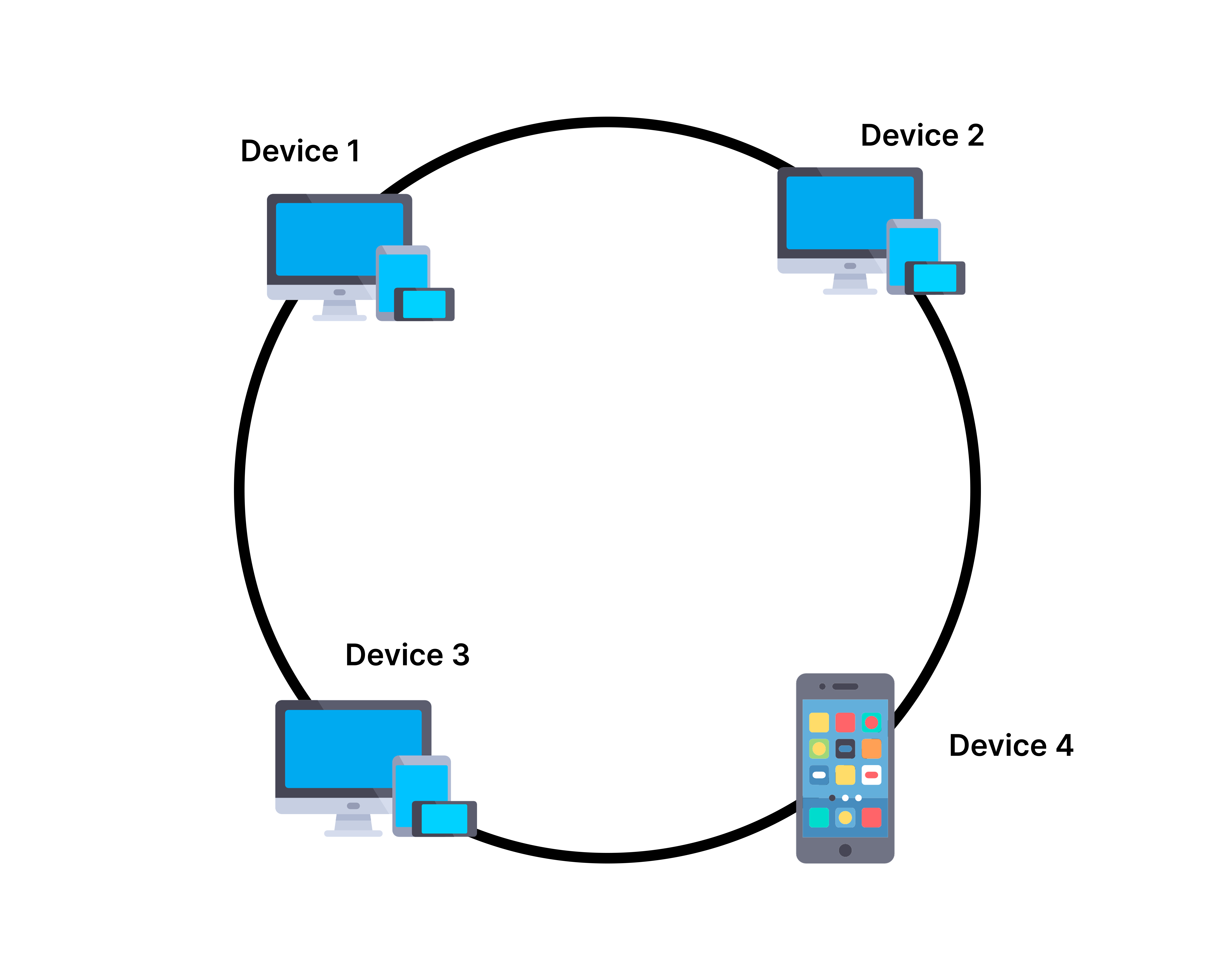
Network topology defines how devices are arranged and connected within a network. Among the various topologies that have shaped the history of computer networking, ring topology holds a distinctive place. Although it has been largely superseded by star and mesh designs in modern LANs, ring topology introduced concepts that still influence network engineering today. This guide explains what ring topology is, how it works, where it is still relevant, and how it compares to other common network layouts.
What is Ring Topology?
Ring topology is a network configuration in which every device is connected to exactly two other devices, forming a single continuous loop. Data travels around the ring in one direction, passing through each device sequentially until it reaches its intended destination. Every device in the ring acts as a repeater, receiving the incoming signal, regenerating it, and forwarding it to the next node.
This circular arrangement means there is no central hub or switch controlling traffic. Instead, the network relies on a disciplined, orderly data flow where each device gets a turn to transmit.
How Ring Topology Works
The operation of a ring network follows a straightforward but effective process.
Unidirectional Data Flow
In a standard ring topology, data packets travel in a single direction, either clockwise or counter-clockwise. When a device wants to send data, it places the packet onto the ring. The packet moves from node to node, with each device checking whether it is the intended recipient. If the data is not addressed to the current node, that node regenerates the signal and passes it along to the next device in the ring.
This sequential forwarding continues until the packet arrives at its destination. Once delivered, a confirmation is sent back around the ring to the sender, and the transmission is considered complete.
Token Passing
The most well-known implementation of ring topology is the Token Ring protocol, originally developed by IBM in the 1980s. Token Ring uses a small control packet called a token that circulates continuously around the ring.
Here is how the process works:
- An empty token circulates around the ring when no device is transmitting
- When a device needs to send data, it waits for the empty token to arrive at its port
- The device captures the token, attaches its data payload along with the destination address, and releases the modified token back onto the ring
- The data-carrying token travels around the ring until it reaches the destination device
- The recipient copies the data and marks the token as received
- The token returns to the original sender, which verifies successful delivery and releases an empty token back onto the ring
This token-passing mechanism is elegant because it completely eliminates data collisions. Only the device holding the token can transmit, ensuring orderly and predictable network communication.
Dual Ring (Bidirectional) Configuration
To address the vulnerability of a single ring, dual ring topology uses two counter-rotating rings. Data normally travels on the primary ring, while the secondary ring serves as a backup. If a cable break or device failure disrupts the primary ring, the network can automatically wrap traffic onto the secondary ring, maintaining connectivity.
Fiber Distributed Data Interface (FDDI), a networking standard used primarily in the 1990s for campus and metropolitan backbones, employed this dual-ring approach. FDDI networks could span up to 200 kilometers and supported data rates of 100 Mbps, which was exceptional performance for that era.
Advantages of Ring Topology
Ring topology offers several benefits that explain its historical popularity.
No Data Collisions: The token-passing mechanism guarantees that only one device transmits at a time, completely eliminating the collision problem that plagued early Ethernet networks using bus topology.
Predictable Performance: Because every device takes turns transmitting, network performance remains consistent regardless of traffic load. There are no sudden slowdowns caused by multiple devices transmitting simultaneously.
Equal Access: Every device on the ring has an equal opportunity to transmit data. No single device can monopolize the network bandwidth, which ensures fairness across all connected nodes.
Signal Regeneration: Each device acts as a repeater, regenerating the signal before forwarding it. This allows ring networks to span greater distances without dedicated signal amplification equipment.
Simplified Troubleshooting: Since data flows in a predictable path, isolating the source of a problem is relatively straightforward. If data fails to reach a destination, the faulty segment is somewhere between the sender and receiver on the ring path.
Disadvantages of Ring Topology
Despite these strengths, ring topology has significant drawbacks that contributed to its decline.
Single Point of Failure: In a unidirectional ring, if any single device fails or any cable segment breaks, the entire network goes down. Every node is critical to maintaining the ring's continuity, making the network fragile.
Difficult Modifications: Adding or removing a device requires breaking the ring, which temporarily disrupts the entire network. In contrast, star topology allows you to add or remove devices without affecting other connections.
Latency Increases with Size: Data must pass through every intermediate node between the sender and recipient. As the number of devices grows, the time it takes for data to complete its journey increases proportionally.
All Devices Must Be Active: Every node must be powered on and functioning for the ring to operate. A single turned-off computer can break the circuit and halt all network communication.
Cost and Complexity: Token Ring hardware, including the Multistation Access Units (MAUs) that physically connected devices, was more expensive than Ethernet equipment. Combined with the cabling requirements for maintaining a continuous loop, ring networks were costlier to deploy and maintain.
Ring Topology vs. Other Topologies
Understanding how ring topology compares to other designs provides useful context.
Ring vs. Star
In star topology, all devices connect to a central switch or hub. If one device fails, only that device is affected rather than the entire network. Star topology is far more resilient to individual device failures and is easier to expand, which is why it dominates modern LANs.
Ring vs. Bus
Bus topology connects all devices to a single shared cable. Like ring, bus topology suffers from a single point of failure if the main cable breaks. However, bus topology is even simpler and cheaper. Ring has the advantage of eliminating collisions through token passing, which bus topology cannot do.
Ring vs. Mesh
Mesh topology provides multiple redundant paths between devices, offering the highest fault tolerance of any topology. However, it is also the most expensive and complex to implement. Ring topology is simpler and cheaper but far less resilient.
Where Ring Topology is Still Used
While Token Ring LANs have been almost entirely replaced by Ethernet, the ring concept lives on in several modern technologies.
SONET/SDH: Synchronous Optical Networking and Synchronous Digital Hierarchy, the standards that underpin much of the world's telecommunications backbone, use ring architectures for self-healing fiber optic networks. When a fiber cut occurs, traffic is automatically rerouted around the ring in milliseconds.
Metro Ethernet Rings: Many metropolitan area networks use Ethernet ring protection switching to provide carrier-grade redundancy for business connectivity services.
Industrial Networks: Some industrial control systems and manufacturing environments still use ring-based protocols for their deterministic performance characteristics, which are essential for real-time machine control.
RPR (Resilient Packet Ring): This IEEE standard optimizes data transport over fiber ring networks, combining the resilience of SONET rings with the efficiency of packet-based data transfer.
Conclusion
Ring topology represents an important chapter in the evolution of computer networking. Its token-passing mechanism solved the collision problem elegantly, and its predictable performance made it reliable for enterprise environments throughout the 1980s and 1990s. However, its vulnerability to single-point failures, difficulty of modification, and higher costs ultimately led to its replacement by star-based Ethernet in most LAN environments.
Despite its decline in local networking, the ring concept continues to power critical telecommunications infrastructure around the world. Understanding ring topology provides valuable insight into how networks manage data flow, redundancy, and fault tolerance, all concepts that remain central to modern network design.
For more networking fundamentals, explore our IP Tools and Traceroute utilities to see how data travels across real networks.